One of the toughest things I've ever learned, and am still learning, is how to guard my heart against the comments of others. Rejection in its many forms can wound deeply, especially if what you are expressing comes from deep within you. If you find yourself crying as you write, you've tapped into something that you deeply feel and intensely want to share with others. Rest assured that there will be people who read your work who just won't get it. They can wound you deeply if you let them.
Thanks to the wonders of the Information Age, reviewers are no longer limited to the local newspaper's Sunday book column. Instead, average people using their home computers can now determine the sales of your work and your future as a writer by posting their opinions at blogs and online booksellers.
If you have a thin skin, that is if you are easily offended, then you might not find this form of feedback to be the acclaim you've desired. My major mental defense against written criticism has been a line about life in the big city from that profoundly deep movie, "Muppets take Manhattan," to wit: "Peoples is peoples." I use that phrase to remind myself that you are going to experience both good and ill from critics because "Peoples is peoples." Count on it. It's a fun maxim that stirs a chuckle instead of a sigh.
Criticism, even ill-meant criticism, can contain nuggets of truth that will strengthen you and improve your work, if you are prepared to receive them. Proverbs 17:10 says, "A single rebuke does more for a person of understanding than a hundred lashes on the back of a fool." Therefore, stay humble and teachable without becoming a doormat for everyone who has an opinion.
As for an emotional defense against rejection, I've learned to guard my heart, first by choosing with whom I will share certain things, and secondly by first examining my motivations for sharing deeply felt observations with anyone. Those closest to you may be unprepared to appreciate your work. Even Jesus experienced this in Mark3:21, "When his family heard what was happening, they tried to take him away. "He's out of his mind," they said."
Jesus warns us in Matthew 7:6, "Do not give dogs what is sacred; do not throw your pearls to pigs. If you do, they may trample them under their feet, and then turn and tear you to pieces." There will be people who won't value what you have to offer them. Simply put, they may not be ready to see the value in your words and may even violently oppose you. Those closest to us though their rejection can hurt us the most. You cannot prove anything to someone who is unprepared to receive it. Give them grace, forgive them, and move on.
Take a deep look at your motivations for wanting to share your work with others. If writing "burns in your bones," then you don't have much of a choice. It can be a bittersweet calling with moments of great loneliness and moments of great joy, especially if your writing reveals the Lord's beauty. However, if you are writing to win the acclaim of others, you can be deeply hurt through the sting of rejection and indifference.
Jeff Gerke in his book, The Art & Craft of Writing Christian Fiction, takes this issue head on in his first section, "The Spiritual Heart of Writing Christian Fiction," Jeff talks about entering a place of fullness in your relationship with God so that you no longer desire the acclaim of others and you are not greedy for success. If you really want to write Christian speculative fiction, it's a necessary place to be.
Should you find the codependent need to earn the love of others, seek counseling to help you find emotional healing. You will be able to help others better and better weather the buffets of a hostile planet. I learned this the hard way and lost years of writing time in the face of even the most feeble criticism. I found I could not articulate my deepest feelings in writing because I was afraid of rejection and hog-tied by it. I found my identity not framed by the opinions of others, but established in my personal relationship with God.
Finally, in experiencing spiritual rejection, take comfort that you will experience rejection because our loving Lord Jesus is daily rejected on many levels. Like Him, we will experience rejection from those opposed to his message of God's love and healing. Like Him, we must also realize that we will be attacked by those under the sway of evil, because as Ephesians 6:12 says, "For we are not fighting against flesh-and-blood enemies, but against evil rulers and authorities of the unseen world, against mighty powers in this dark world, and against evil spirits in the heavenly places."
Our work is not only read by humans, but by those beings who have spiritual connections to their unsuspecting mortal hosts. Therefore what we write is transmitted to infernal places where the truth of the Gospel is deeply feared. As James 2:19 says, "You say you have faith, for you believe that there is one God. Good for you! Even the demons believe this, and they tremble in terror."
Our writing as a testimony of our faith will earn on-going spiritual attacks. Revelation 12:11 says, "And they have defeated him by the blood of the Lamb and by their testimony. And they did not love their lives so much that they were afraid to die."
Count on big-time opposition, stand firm, and spend time before God daily in prayer, in His word, in meditation, and in worship. In doing so, you don the whole armor of God found in Ephesians 6:10-20 and like Paul serve as an ambassador of life to a dying planet.
Sunday, November 21, 2010


Saturday, November 13, 2010
To live and die a writer - Robert Louis Stevenson
 |
| American painter John Singer Sargent's portrait of Robert Louis Stevenson |
Today marks the 160th birthday of one of the most widely translated and beloved writers, Robert Louis Stevenson (1850-1894). His creative genius gave us Treasure Island, Kidnapped, and the dark speculative novel, Dr. Jekyll and Mr. Hyde. Though many know him as a novelist, he was also a poet, essayist, and travel writer.
The son of a devout Scottish Presbyterians, Stevenson by turns moved away from Christianity as he saw it practiced. Yet later in life while battling chronic respiratory illness and depression, he showed great courage in standing up for the rights and dignity of native peoples, particularly the Samoans, who he came to know and love through his residence in the South Pacific.
While in Hawaii and following the death of Father Damien DeVeuster, he went with great anticipation to investigate the rumors that the Catholic priest had contracted leprosy though intimate relations with female lepers while ministering at the leper colony on the Hawaiian island of Molokai.
Instead, the first-hand accounts of Father Damien's 16-year ministry of selflessness and resourcefulness profoundly affected Stevenson. A former Presbyterian missionary to Molokai, Charle M. Hyde, asserted that the rumors of of the priest's misconduct were true. In a letter to a fellow pastor, Hyde characterized Father Damien as "a coarse, dirty man" whose leprosy should be attributed to his 'carelessness'."
Stevenson hastily wrote a stinging rebuttal that left the author fearing he would be sued for libel. In the open letter, Stevenson condemned Hyde for an anti-Catholic bias that blinded him to the worth of Father Damien's work. He also warned Hyde that his own mission work might well become eclipsed by this condemnation of a true Christian saint. This last warning proved prophetic when the Catholic Church canonized Father Damien on October 11, 2009.
While Stevenson had great respect for Christian missionaries in the South Pacific and counted many as friends, there is some doubt that Stevenson was a Christian. His own pronouncements and family history seem to show that Stevenson who flirted with a good many beliefs and did not have a personal relationship with God.
In the Grace Evangelical Society article, "Robert Louis Stevenson: So Near, Yet So Far," author James Townsend portrays Stevenson's life-long tortured struggle to know God. In the end, the only way we may know for certain if Stevenson knew Jesus is to see him standing among the elect in Heaven. For my part, I hope I get to see him there, shake his hand, and thank him for many wonderful hours of reading his books.
If you have not had the opportunity to read his work, do so. If you haven't had the opportunity to read Treasure Island aloud to a child with all the right pirate voices, visit your local library and offer your services. In doing so, you will be firing the imagination of young minds and encouraging them them to read the work of truly great authors. Discriminating Christian parents can appreciate the Stevenson's unquestioned talent and still discuss with their children any ambiguities that may surface while reading his work.
Stevenson's struggles with Christianity show that Christian speculative writers must have a strong relationship with God so that evil does not eclipse the Gospel message. If you are a writer of Christian speculative fiction, listen to the still, small voice of the Holy Spirit as you write and confirm it in the Scriptures so there will be no doubt as to your witness.
As Marcher Lord Press publisher Jeff Gerke says in his book The Art & Craft of Writing Christian Fiction, "But in the end, you must let God be in charge of taking your fish and loves and multiplying them out to the people He knows needs them." That can only happen if you know Him.
Sunday, October 31, 2010
On the gruesome art of keelhauling
 |
| 16th century victim suffers keelhauling, an ancient punishment. |
At the sound of a cannon shot, the punishment detail let go of the rope and the victim fell into the sea. The punishment detail or perhaps the entire ship's company then hauled briskly on the rope on the opposite side of the ship, drawing the victim along the hull on one side, then over the ship's keel. From there the rope dragged the victim over the opposite side of the hull until the victim was hoisted up on the other yardarm, where he might hang for a quarter of an hour. There are accounts of keelhauling being repeated several times as 17th century author Christophorus Frikius claimed to have witnessed in his 1680 book Christophorus Frikius's Voyages to and through the East Indies.
On large ships, victims were keelhauled from port to starboard while on smaller vessels they had to endure being keelhauled from bow to stern. If a ship had not been recently careened, then the victim had to pass over razor-sharp barnacles and marine grown, causing numerous cuts and perhaps even a decapitation. If not drowned outright, then the victim could die from painful wounds caused by keelhauling.
The Dutch and later other European Navies appeared to start using keelhauling in the 16th century. There is some doubt if the practice was officially condoned in the British Royal Navy, although I've run across a reference to it happening before 1797. The practice continued in the French Navy until finally abolished in the mid-1800s. There is an account of a keelhauling of two Egyptian sailors by the Egyptian Navy in 1882 at Alexandria, as mentioned in the The House of Commons Papers, Volume 33, 7 February -- 2 December 1882.
However, keelhauling may have not been an modern invention. Ancient Greek vases appear to show ancient pirates or sailors be punished in this way.
The reputation of this brutal punishment caused slang English to use the the word keelhauling for rough treatment.
For writers of pot-boilers during the 1800s, walking the plank and keelhauling were standard plot staples. I've even spotted a typo from that time, where the author actually meant close-hauling, which is a point where the sailing ship is almost but not quite sailing, rather than the word keelhauling. It is alas, a word that sticks in your mind, even if you don't know what it means.
Tuesday, October 19, 2010
Book Review - Hero, Second Class
 Hero, Second Class by Mitchell Bonds
My rating: 5 of 5 stars
In which the reviewer expounds upon the notion that this is a Whacking Good Story, featuring heroic derring-do and perfidious villainy amid slaughter on a monumental scale, a Touching Love Story, and a good many puns.
Cyrus Solburg is the squire of the noble-hearted though dense hero Sir Reginald Ogleby, known as the Crimson Slash. Endowed with superhuman powers and desire to express them, heroes like the Crimson Slash fight villains with similar inclinations in a medieval world populated with a number of sentient races and various magical creatures. The two groups are regulated by the International Guild of Heroes and it's sinister counterpart, the Brotherhood of the Black Hand.
The two guilds manage an on-going stalemate, hoping to avert a second worldwide war. The first world war was fought by heroes and villains, using the full onslaught of their powers. Known as the Twenty Minute War, this conflict lasting 20 minutes nearly ended all life on the planet.
Enter the arch-villain Voshtyr Demonkin, who is determined not to repeat the mistakes his side made in that disastrous conflict. With the unfolding of Voshtyr's dastardly plot, things do not look good for our heroes.
Hero, Second Class by Mitchell Bonds takes more than a few gentle swipes at the fantasy genre. OK, general head-bashing is more like it. Therein lies the strength and weakness of this very likable tale, which refuses to take itself seriously, yet is part of an underlying heroic epic Mitchel calls The Hero Complex.
I would favorably compare Hero, Second Class to other classic humorous fantasy stories that include L. Sprague De Camp's The Compleat Enchanter, one of my all time favorites.
Christian concepts are integral to the story, yet do not bash the reader with an overt evangelistic pitch. To paraphrase fantasy writer Terry Pratchett, this story is about looking at life in an entirely new way.
Hero, Second Class is a story that I could re-read, especially should the next installment of the Hero Complex be released. I would recommend it to fantasy lovers who love gentle puns, marvelous heroic feats, and do not mind Capital Letters in the least.
View all my reviews
Saturday, October 16, 2010
Book Review - Lord's Prayer by R. T. Kendall
From time to time, I will recommend books for a Christian writer's devotional bookshelf. A close relationship with God can only help us offer life and hope to a dying world.
 Lord's Prayer, The: Insight and Inspiration to Draw You Closer to Him by R.T. Kendall
My rating: 5 of 5 stars
I found Lord's Prayer by R. T. Kendall to be not only thought-provoking, but a very good read. Books of this nature often tread the line between scholarly and popular works with very stilted prose. Kendall's writing has a clarity, flow, and freshness that brought new illumination to Jesus' model prayer about which millions of words have been written over the centuries.
I particularly liked Kendall's passages on the role of the Holy Spirit in "Thy kingdom come." He describes what that will mean to the church as God begins to move powerfully when our focus shifts from our own wills to His will.
I am not one to normally read the recommendations at a book's beginning, preferring for the book to stand on its own merits. I was struck by the diverse viewpoints of Christian leaders who could recommend this book, ranging from members of the Southern Baptist Convention to the current president of Oral Roberts University. I believes this speaks very powerfully about its contents.
I discovered Lord's Prayer by R. T. Kendall to be a life-giving book and not a recycled sermon you might find on a book table at a Christian conference. I believe as you read this book you'll have "aha moments" as I did. For some, it will shift prayer away from just personal petitions to unselfish prayer that yearns for God's will to be accomplished.
As a disclaimer, publisher Baker Publishing Company furnished a review copy of Lord's Prayer. The receipt a book in no way affected my review.
View all my reviews
Wednesday, October 13, 2010
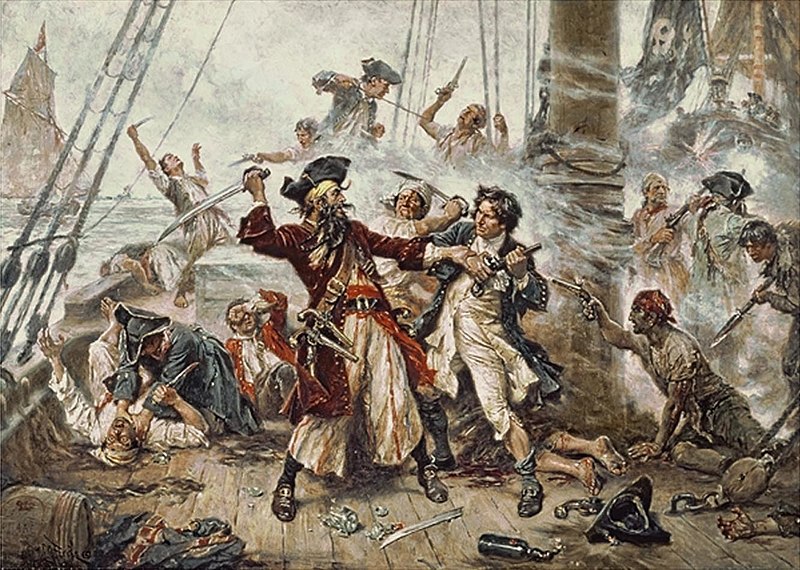
Choosing a villain
 |
| Blackbeard's last moments. |
In choosing a character for a historical novel, I do what I do best and research the time and its people. Pirate history is very colorful and there are no end of books. A careful look at their bibliographies shows there really are a handful of sources, notably Captain Charles Johnson (who is generally conceded to really be Daniel Defoe) and the earlier Alexander Oliver Exquemelin. Of the two sources, Exquemelin actually served as a surgeon aboard a pirate vessel. There is a vocal faction who believe that Captain Johnson was a real pirate, but that has never been proven. And too, the content of the Defoe/Johnson book is now regarded as part fiction.
Twentieth century researchers like Jan Rogozinski Dictionary of Pirates (1997) helped to organize what we do know about the major and many minor pirates. Still, there are gaping holes in our knowledge of piracy in the early 1700s. English, French, and Dutch pirates are generally known, but other nationalities are glossed over, perhaps because there is not much to tell other than a line or two that would resemble today's police blotters.
I became intrigued by a "real-life" pirate Nick Catania, whose fleet according to the Kingston, Jamaica entry in Wikipedia, was responsible for the 1703 fire that gutted Port Royal, Jamaica. But try as I might, I could not find a single mention of Catania, even by the governor of Jamaica in his official report to the Crown, days after the fire. There is another explanation for the Port Royal fire that does not include a pirate fleet or any kind of fleet, which I hope to include in an upcoming posting.
I've come to suspect that the 'historical' pirate Nick Catania is either a very minor pirate not worthy of much mention, an online hoax, or the Jamaican equivalent of Mrs. O'Leary's cow of the Chicago fire fame. The only source for the pirate Catania appears to be Wikipedia. Other web sites are merely quoting what they've found there. Looking for other sources, I tried to contact regional experts. Inquiries to Jamaican historians and even the Daily Gleaner have never been answered.
I loved the sound of the name 'Nick Catania' and there were pirates from the Mediterranean operating in the Atlantic during the 1700-1703 time frame, which are key years for my pirate stories. Additionally the Sicilian province of Catania has a pirate or two associated with it, notably the late 15th century Paolo de Campo, who along with his arch-rival Black Hassan preyed on Venetian merchantmen. For the dark aspects of these stories, the province of Catania also has a history of witchcraft and heresy, not to mention the active volcano Mount Etna, that fit in well with my character's charming yet evil and volatile personality.
For Nick Catania's physical description and emotional makeup, I drew from descriptions of Edward Thatch (Teach) AKA Blackbeard and Bartholomew Roberts, of which we do know a good deal.
I am pleased with the resulting character of my fictional Nick Catania. I hope when you get the opportunity to read Black Flag, Black Ship that you agree.
Sunday, October 10, 2010
Feedback for future postings
It looks as if some of the book reviews and historical pieces are the most often read here at Holy Speculation in an Unholy World.
If you are a regular reader of Holy Speculation, would you take a moment to give me some feedback about this blog. I would like to ask which specific blog postings were your favorites and which you thought were stinkers. What type of posting would you like to see (flash fiction, historical background, reviews, essays, etc.) and which I should heave over the side.
Finally, could truthfully say you'd recommend this blog to a friend? If the answer is yes, would you take a moment to do so?
Subscribe to:
Posts (Atom)

 Posts