Takaom Universe

Takaom Universe
Save your planet!

Friday, August 20, 2010

Book Review - The Word Reclaimed

The Word ReclaimedThe Word Reclaimed by Steve Rzasa
My rating: 5 of 5 stars


The Word Reclaimed is an Excellent Christian military SF novel told from multiple viewpoints.  In the distant future, Mankind has spread out across the stars and the majority of humanity is ruled by an imperial family who control a number of star systems in what is called the Realm of Five.

To maintain stability, the royal family has banned religions that claim to have an exclusive grasp of religious truths. A highly efficient secret police enforces the ban ruthlessly, pursuing violators across human-controlled space.

Baden Haczyk, the son of a freighter captain finds a rare book on board a mysteriously destroyed freighter that soon embroils everyone he loves in a far-flung conflict for control of the empire.

Steve Rzasa has written a tightly woven, fast-paced tale of empire, intrigue, belief, and battle that fits in well with classics like Jerry Pournelle's Mercenary, Poul Anderson's Star Fox, and Robert Heinlein's Starship Troopers.  Space and ground battles and the associated military technologies are well-conceived and exciting without drowning the reader in a mass of detail.

The characters a believable and compelling.  Character development is on par for a multiple viewpoint story. I would have liked have seen more character development for some of the story's heavies.  Nonetheless, I was thoroughly engaged and rooting for the good guys.

Rzasa handles religious issues well, since they are integral to the story.  His even-handed and thought-provoking approach is commendable.

As part of a two-part story arc, the book does lead tightly into the sequel, The Word Unleashed, which I very much look forward to reading. The Word Reclaimed can be read on its own, but if you're like me, you will want to find out what happens to your favorite characters.

View all my reviews

Sunday, August 15, 2010

Salvage divers in the age of sail

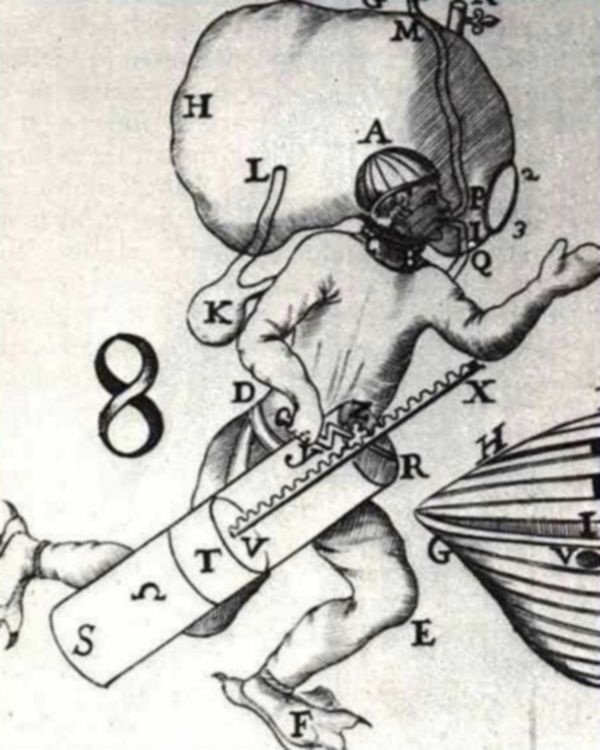
Giovanni Borelli's 17th century drawing shows his ideas for diving gear.
 
In the age of sail, salvaging shipwrecked cargo was big business.  This was a natural offshoot of the transportation of wealth on a worldwide scale by the Portuguese and Spanish in their treasure fleets and the English, and Dutch in their East Indiamen.

The vast distances these ships traveled meant that an unhealthy percentage of them would not make it to home port, either victims of  navigational error, storms, or piracy. 
 
Battle and storm damage as well as the ravages of marine growth prematurely aged even the most stoutly made hulls. As a practical matter, Spanish galleons were required to carry a diver who was used to find leaks when an inspection inside the hull couldn't locate them. 
 
Spanish colonial ports had salvage divers and the necessary equipment to rescue a ship's cargo from shallow depths up to 50 feet.  These men were paid two and half times the going rate for an ordinary seaman, reflecting to an extent the hazards of their profession.  Additionally they received bonus payments for retrieving treasure and cannon.

The fanciful 1680 illustration of Giovanni Borelli's proposed underwater breathing apparatus to the best of our knowledge was never built. Instead as done centuries before,  free divers used stones to quickly descend to the bottom.  
 
These divers spent about three minutes under water before having to take a breath.  In the Caribbean, black pearl divers were sought out for their excellent underwater vision. There were reports of Caribbean Native American divers who could dive for up to 15 minutes, but historians have discounted these as embellishments.
 
The taxing nature of the work meant that a single diver could only make one deep dive a day.  Consequently salvagers had to have many divers available.  Even then the profession was very deadly with men drowning or suffering from pressure related ailments, some of which were fatal.

Caribbean Native American divers were heavily sought for Spanish salvage operations. To augment these divers, black slaves were pressed into service, with reports of freedom being granted to some for being the first to retrieve treasure from a wreck.

Surface crews assisted the divers, using derricks to raise heavy objects like brass cannons. The surface crews  also used grappling hooks and long-handled tongs of the same sort as used by oystermen to retrieve small objects.  The divers attached ropes to large objects, such as cannons, and gained entry into the wreck to retrieve cargo there.
 
For wrecks in deeper waters and where the wrecks were in calm sites,  salvagers used metal diving bells, some of which were even equipped with small glass windows to allow for more efficiency. The divers could either use the diving bell's air to extend bottom time or they could work sitting inside the bell. Even so, the air quickly fouled.
 
I have read of barrels being use to transport air to a diving bell, but I don't know how practical that proved.  Also working at a reef on in shallow coastal waters diving bells did not prove to be very practical as they could easily tilt and lose their precious air.  As effective as early diving bells could be for salvage work, they worked best only under ideal conditions.

Frequently ships broke up on reefs and the contents of these vessels could be scattered for some distance. This kind of wreck called for divers and surface salvage work. Depending on wave action and currents, debris from a wreck could be covered and uncovered by shifting sand from season to seadon.  Salvage operations could go on for years, even decades, depending on the cargo's value and ease of access to the wreck site.

Rather than mounting their own salvage operations, pirates waited for the treasure to be retrieved and then attacked the salvage vessels.  Consequently, Spanish salvage operations used a number of heavily armed frigates to ward off poachers and attackers.

In Black Flag, Black Ship,  a certain pirate crew employs divers for a very mysterious purpose.  Read Black Flag, Black Ship to find out!

Sunday, August 8, 2010

Pirate Hunters - Lieutenant Stephen Decatur Part II

     Captain Stephen Decatur storms an enemy gunboat.

On Friday, August 3, 1804, the American squadron again approached Tripoli, where Lieutenant Stephen Decatur, now Captain Decatur, months earlier had blown up the captured USS Philadelphia right under the very noses of the Barbary pirates.

American squadron commodore Captain Edward Preble again approached Tripoli to show American resolve in protecting U. S. vessels and sailors from pirate attacks. With limited resources, he could not invade Tripoli or completely destroy the fortifications and vessels guarding Tripoli.  He could hurt the Barbary pirates enough to make them come to terms with releasing the captured captain and crew of the USS Philadelphia and to help them think twice about attacking other American vessels.

Preble planned  a daring assault.  At 2:30 PM, he boldly advanced the squadron to point blank range and commenced the attack.

Earlier, he had dispatched six gun boats, three each  under the command of Captains Decatur and Sommers. Prebble ordered them to cause as much damage as possible, board enemy vessels, seize them and their crews and then leave the harbor with their prizes.

He had also directed two bomb ketches, two-masted vessels armed with heavy mortars, to bombard the fortified positions and the town.

The heavy frigate USS Constitution under Preble's command and her attending ketches and brigs were to provide covering fire for the attacking gunboats and fire upon the Pasha's Castle, Fort English, and other fortified positions.

Against their six gunboats, the Barbary pirates had 19 gunboats with full compliments of 30 to 50 crewmen. Each opposing gunboat had a heavy gun in the bow, with two lighter guns in the stern.  The shore artillery in the fortified positions held an estimated 120 guns.

Pasha  Yusuf Karamanli of  Tripoli  treated the upcoming attack with contempt, making a number of disparaging insults about the Americans. After all, he held the captain and crew of the USS Philadelphia in his dungeons.

The Barbary pirates in the gunboats at anchor beneath Tripoli's heavy guns  reflected their leaders'  disdain for the Americans. They did not even bother to make ready to sail in case the attack came close to their positions.  Some citizens of Tripoli sat on their rooftops to watch their anticipated victory.

As the attack commenced, contrary winds drove Captain Sommers and one of his gunboats away from the enemy gunboats. Sommers was able to work his way to the rear of the enemies gunboats, causing considerable havok there but was unable to seize a gunboat.

Captain Decatur's division of three boats succeeded in reaching the pirate gunboats, aided by Lieutenant James Decatur's gunboat.  Lieutenant Decatur was Captain  Stephen Decatur's brother and had been assigned to Captain Sommer's boat division.

When  the American gunboats approached the enemy, the USS Constitution and the rest of the American squadron alternately  fired shot at the fortifications and  grapeshot at the enemy boats, literally sweeping those vessels of all crew on deck.  The enemy positions returned fire, succeeding in striking the attacking ships.  During the battle, the enemy gunboats attempted several times to surround the squadron as they had successfully done with the USS Philadelphia. Captain Preble and his men beat off those attacks.  Through skillful maneuvering, Preble kept the Constitution where she was needed most to carry the attack to completion.

Captain Decatur in Boat No. 4 boarded one gunboat with his crew of fifteen men and after hand-to-hand fighting  took it as a prize.  Lieutenant Tripp in Boat No. 6 also succeeded in taking one enemy gunboat as  a prize. Lieutenant Bainbridge in Boat No. 5 had the lanteen yard holding the boat's mainsail  shot way, preventing him from taking a gunboat.  He was able to support the attack with steady musket fire from his boat.

Lieutenant James Decatur in Boat No. 2 attempted to board an enemy gunboat, which promptly raised a white flag.  As Lieutenant Decatur stepped aboard the enemy gunboat, he discovered the surrender was really a ruse. The enemy commander shot James Decatur in the head. As the enemy vessel escaped, James Decatur's second in command Midshipman Brown retrieved him and took him to the USS Constitution where James Decatur died within minutes of boarding the Constitution.

Captain Decatur  divided his crew between the captured boat and his own boat.  As he was returning to the squadron he learned that his brother  had been killed.  An officer who was highly regarded in the squadron,  Lieutenant Decatur's loss was keenly felt.  Captain Stephen Decatur immediately set out to find the Barbary pirate captain who had killed his brother.  Decatur's reaction was not only the anger of a brother, but also the anger of an officer who had a comrade killed in such a base way.

Accompanied by Midshipman MacDonough and nine sailors,  Captain Stephen Decatur succeeded in finding the enemy captain's vessel and boarded it.  They faced a full compliment aboard the gunboat.  Decatur made his way to the enemy captain, who managed to wound Decatur in the arm and chest with a spear.  A stronger man than Decatur, the Barbary pirate captain pressed Decatur to the deck, where he intended to kill him with a dagger.

A Barbary pirate came up with a sword to aid his captain and kill Decatur. One of Decatur's men who had been wounded in both arms threw himself between the pirate's sword and Decatur, suffering a fractured skull in the process. No one is quite sure if this sailor was Reuben James or Daniel Frazer, both of whom at various times fought under Decatur.

Nonetheless, this unselfish act allowed Decatur to pull a pistol out of his pocket and shoot the enemy captain.  Decatur and his men captured the gunboat and returned to the squadron with a second prize. Only four of Decatur's men were unwounded.

Enemy causalities on board the two prizes taken by Decatur and his men consisted of 33 Barbary pirate officers and crewmen killed. Another 27 Barbary pirates had been captured with 19 seriously wounded.

The action ended at about  5 PM.  Lieutenant Decatur was the only person killed.  Two officers and eleven sailors were wounded.

As Lieutenant Decatur's brother, it fell to Stephen Decatur to clean his brother's corpse and to prepare  him for burial the following day.  He sat through the night keeping vigil over his brother's body.

Sometime during the night, Decatur supposedly said to Midshipman Charles Morris as he gazed down at his brother's corpse, "I would rather see him thus, than living with any cloud on his conduct."

Afterward, Captain Decatur's showed great compassion to the wounded pirates captured in the raid, reportedly even asking Captain Preble if  the seriously wounded pirates could be returned  to Tripoli where they could get better treatment.

In Tripoli, reaction to the American attack was one of panic.  Ordinary citizens fled Tripoli. The Pasha was said to be in hiding in a bombproof room.

A leader of Tripoli asked on of the USS Philadelphia's imprisoned officers if the attackers were truly Americans or devils in human form.   He complained that the English, French and Spanish consuls had told the leaders of Tripoli that America was young nation that got its independence because of French strength. They led the Barbary pirates to believe that the Americans could not protect their own merchants so the  pirates could expect a brisk business taking American ships and crews for ransom.

The Barbary pirates realized that they had greatly underestimated the resolve and fighting ability of the U. S. Navy. One of the wounded Barbary pirates returned by Captain Preble was supposed to have said, "The Americans in battle are fiercer than lions and after victory, kinder than Muslims."

As shaken as the Pasha was after the August 3rd attack, he was not yet ready to give up the Philadelphia's crew.

Saturday, July 24, 2010

The bunko mates

The clipper ship Challenge -- a marked ship

Ship discipline has always been a problem for sailors and their officers.  In history you can find splendid examples of officers who were firm and enforced their articles of discipline without brutality. They led their men through personal example, positive discipline, and a genuine concern for sailor welfare. 

Admiral Lord Horatio Nelson is a splendid example as is his American contemporary Captain Stephen Decatur. Incidentally, I will soon write two more installments about Decatur's brushes with pirates and his later years.

In fiction,  Patrick O'Brian's Captain Jack Aubrey and C. S. Forester's Horatio Hornblower are officers who detest the lash and uses it sparingly.

As a young U. S. Army officer, I often heard the maxim, "Lead by example."   Over the years, I've discovered that the path to greatness or infamy stems from how one leads by example.

In the 18th and 19th centuries, condition at sea were brutal. Men aboard both warships and merchantmen fought the elements and endured tainted foodstuffs, with death a daily possibility. At times seamen at the end of their physical and mental limits were hard pressed to endure much more. 

Good leaders coaxed and encouraged their men without coddling.  Bad leaders found that for the short term the liberal application of bullying and brutality achieved results.

Since captains were absolute monarchs when their ships were at sea, it was very easy to slip into the dark ways of leading a crew. These ships were often called ships of blood.

Even if men were killed and maimed during discipline, it was very difficult to determine who did what to whom once the ship reached port. Often sailors simply jumped ship and no one in authority was the wiser.

Captains rarely disciplined men directly, relying on the junior officers to keep order.  On ships where blood ran freely, the first and second mates were called "bucko mates." They carried belaying pins or tarred rope and used them with enthusiasm. These officers defended their actions, stating that Johnny Tars were anything but gentlemen and life aboard ship called for bigger and meaner men to keep them in line.

In U. S. Maritime history, the voyage of the Challenge in 1851 is a notorious example of the violence wielded by "bucko mates." Captain Robert "Bully" Waterman was in a bad way. He had the clipper ship Challenge to take around the Horn to San Francisco with $60,000 of freight, a few experienced men and the rest of the crew the scrapings of the docks.  He could earn a $10,000 bonus if he made it to San Francisco in 90 days.

When James "Black" Douglass offered to come aboard  as first mate, Waterman gladly accepted him.  Former sailors under Douglass were waiting for him  to step ashore. The Challenge was his ticket out of New York in a hurry.  Waterman no doubt believed he could win his bonus if Douglas could get his crew in shape.  Douglass' reputation for sadistic brutality was well-known.


Before the voyage ended one man would be knifed to death, and the rest save one man were beaten.  On October 29, 1851, the Challenge arrived in San Francisco after 102 days at sea. Sailors on the docks, who saw men being carried off the Challenge on stretchers, became so angry that they chased both Waterman and Douglass for the better part of a day.  The mob was determined to lynch both men from the yardarms of the Challenge. Both men turned themselves into the authorities for protection and they were eventually brought to trial.  

Prosecuted in the the Federal Court of  Judge Odgen Hoffman under a U. S. law written in 1835, the law called for punishment of ship's officers when it could be clearly established that sailors were mistreated.  The law was so vague that successful prosecutions were rare.

With the California Gold Rush in full height,  entire ship crews deserted and took off for the gold fields once they anchored in San Francisco Bay. Only a few witnesses could be rounded up and they provided contradictory testimony.  Perhaps most damaging was the testimony of crewman Charles Pearson, a Navy veteran who served under Steven Decatur. He said he had been beaten,  but admitted that the crew was a miserable lot.

In the end, the crewmen were exonerated.  Waterman was fined $400.00.  Douglass was fined $250, and the second mate Andrew Coghill was sentenced to 30 days in jail.  There is a small measure of justice in that Waterman's obsession with crew discipline no doubt contributed to his slow voyage  and loss of the $10,000 bonus. 

The Challenge became a marked ship.  The owners had such a difficult time finding crew for her that the new captain had to offer $200 head money.  As for the two men who gave her the tainted reputation, they never served on another ship, as far as anyone knows. 

Waterman never left California. Instead, he started raising  poultry and cattle.  Later he became San Francisco's port warden and inspector of hulls. As for the bunko mate Black Douglass, beyond never signing on another ship, it's as if he stepped off history's page.

 In Black Flag, Black Ship, we meet Liam Gallagher, a vicious bunko mate aboard the slave ship Vanity.  Will Gallagher get a free hand to fulfill his sadistic urgings?  Read the book to find out what happens to him.


Friday, July 16, 2010

Review: The Dark Man

 The Dark ManThe Dark Man by Marc Schooley

My rating: 5 of 5 stars


Set in the not-too-distant future, this book is a quirky, surreal adventure story that is an emotional roller coaster up to the book's climactic end. Charles Graves is a master of disguise, a government agent dedicated to uncovering underground churches and "reclaiming" its members for a terrifying state religion and its censorship of every form of expression. Outwardly at the top of his game, inwardly Charles is unraveling at a terrifying rate.  I hesitate to say much about the excellently woven plot and vivid characterizations as it might reveal too much this book's great story.  I can say that this book is definitely an adventure book that oddly enough reminds me a bit of Roger Zelazny's Doorways in the Sand with its quirky mental puzzles and The Scarlet Pimpernel by Baroness Emmuska Orczy. It is definitely a story of personal redemption and the price one has to pay to do the right thing.  This is a book I will recommend to my friends and I will re-read it.

View all my reviews >>

Sunday, June 27, 2010

Pirate Hunters - Lieutenant Stephen Decatur Part I

U.S. Navy  Lieutenant Stephen Decatur and his men escape after a daring raid against Barbary pirates.

In 1804, U.S. Lieutenant Stephen Decatur received orders that would make him a hero in the eyes of his countrymen and ultimately the youngest captain in the U. S. Navy's history. 

The newly formed United States dispatched a U.S. Navy squadron to the Barbary Coast of North Africa to prevent U. S. merchant sailors from being taken captive by the Barbary pirates. 

As I've recounted before, the pirates of  North African for centuries raided European shores and captured ships, taking thousands of Christians captives for the North African slave market. The European powers, including the Muslim Ottoman Empire, tolerated the raids and often supported the Barbary pirates as a surrogate navy against rival nations.

Ships of the U. S. squadron pursued the Barbary galleys wherever they found them.  Unfortunately, in one of those chases, the USS Philadelphia ran aground on on uncharted Kaliusa reef  about five miles east of Tripoli.  Quickly surrounded by gunboats from Tripoli and under bombardment from the gunboats and shore batteries, Captain William Bainbridge after several hours of trying to free the Philadelphia in the face of a falling tide surrendered his ship and men to the pirates. The pirates later re-floated the Philadelphia and took the ship to Tripoli. Bainbridge and his men were enslaved.

Fearing that the frigate Philadelphia would be a dangerous addition the pirate ships, both as a warship and model for Barbary frigates, Commodore Edward Preble  ordered Lieutenant Stephen Decatur to enter Tripoli's harbor and destroy the Philadelphia.

The ship they used was a French ketch built for Napoleon's invasion of Egypt. It was later sold to Tripoli  and renamed the Mastico. 

The American squadron captured the vessel and seized it after learning from an eyewitness that the Mastico was one of vessels that had captured the Philadelphia.   Commodore Preble ordered the ship now renamed the Intrepid to make the attack since it was a vessel familiar to the Barbary pirates.

Disguised as Maltese traders, Decatur and his detachment of nine Marines and 65 sailors aboard Intrepid on February 16, 1804, were able to enter the harbor without exciting suspicion.  Using a ruse that their ship had lost its anchors during a storm, they asked permission to tie up to the Philadelphia. 

The plan almost went bad when someone aboard the Philadelphia noticed that the Intrepid still had its anchors. Decatur and his men then boarded the Philadelphia, captured or killed all but two of its enemy crew without firing a shot, and then set it afire.  

Decatur stayed aboard until he was sure that the fire could not be extinguished.  By now shore batteries were firing on the Intrepid as Decatur and his men tried to escape. The Philadelphia's guns began to cook off and the frigate's gunfire into the town may have helped suppress the shore batteries. When the flames reached the powder magazine, the Philadelphia blew up. Lieutenant  Decatur and his men were able to get safely way without a single American raider killed.

British Admiral Lord Horatio Nelson, who that time was blockading the French military port of Toulon, called the action, "the most daring of the age."  It earned Decatur  the acclaim of a nation and set jealousy festering in the hearts of service rivals with horrible results.

Pirate Hunters - Lieutenant Stepehn Decatur Part II

U. S. Navy  Lieutenant Stephen Decatur, foreground,  and his men battle a Barbary pirate during the  daring raid of August 3, 1804.